
AI Is Getting Smarter. Are We?
By Ezra Muinde on Sep 15, 2026 - 12 min read
Ubuntu Analytiq insight“We were given intelligence to steward, now we outsource it and call it progress”
I haven’t written in a while. In the last few months, while in exile, I discovered a few interesting things. They are really none of your business, but since you are already here, I’ll be brief: life is hard, you are not that important, your life is not entirely about you, you are not in control, and finally, you are going to die 💀.
Also, this article is deliberately a little longer than usual. You have been asking AI to summarise enough things lately, so today, you are going to read.
Stay with me, Amigo.
My favorite verse in Genesis is Genesis 2:7. I know most people keep their favorite verses somewhere in Psalms because you all open the Bible when you need some motivation, got you 😂.
But Genesis 2:7 has been sitting differently with me since this article Why Building Machine Learning Algorithms Is Easier Than You Think
God forms man from the dust of the ground, breathes into him the breath of life, and man becomes a living being. There is something about that picture that I find fascinating, especially now that we are spending so much time talking about intelligence, machines, reasoning and what computers might eventually become.
Before we talk about artificial intelligence becoming more intelligent, maybe we should first ask what makes human intelligence human.
We are not just information-processing machines. We live, we experience things, we make mistakes, we misunderstand people, we lose money, we build things nobody wants, we get embarrassed, we fail publicly, we change our minds, we watch businesses succeed and collapse, we learn how people behave, and then we have to live with the consequences of the decisions we make.
Somewhere inside all that mess, something gets formed that is much harder to download.
Judgment.
Now, I don’t know what Sam Altman — or any of the other AI CEOs — breathed into these machines 😂, but whatever happened, they have become incredibly capable. They can write, code, analyse, research, explain, recommend, summarise and increasingly tell us what we should probably do next.
And that is where my question begins.
We have spent the last few years asking how intelligent AI can become.
I am increasingly interested in the opposite question:
As AI gets smarter, are we getting smarter too?
Because my concern is not that AI is becoming human. My concern is that we may become so comfortable outsourcing reading, writing, coding, analysis, interpretation and eventually judgment that we slowly become the artificial layer ourselves.
Four Months? Why?
Yesterday, I was speaking to a friend who is building an interesting platform around data and AI, and they told me they plan to launch it in about four months.
My reaction was almost automatic.
Four months? Why?
We have Claude, ChatGPT, Cursor and AI agents. You can generate a front end, build APIs, debug code, create documentation, design databases and deploy applications faster than at any other point in software development.
So what exactly are the four months for?
The more I thought about that question, though, the more I realised I might have been asking the wrong one, because maybe those four months are not really for writing code.
Maybe they are for talking to students, understanding how they currently solve the problem, building something, putting it in front of them and discovering that the idea you thought was brilliant is not actually as brilliant as you imagined.
Maybe the four months are for watching people use the product differently from how they told you they would use it, changing your assumptions, understanding the business model, getting things wrong, collecting feedback, learning the market and slowly understanding the consequences of the decisions you are making.
Maybe that is actually where the product becomes valuable.
Not because the code gets better.
Because the judgment behind the code gets better.
And increasingly, I think judgment is going to become one of the most valuable things in the age of AI.
Everyone Has Claude Now
Think about a modern organisation today. The intern has ChatGPT, the analyst probably has Claude Pro, the software engineer has Cursor, the manager has Gemini or ChatGPT, and somewhere across town your competitor has subscribed to all of them, connected half of them to an n8n workflow and is probably automating something while you are still reading this sentence 😂.
So where exactly is the competitive advantage?
For a while, simply knowing how to use AI felt like an advantage. Then we talked about prompt engineering, then agents, then workflows, then context engineering, and now we are building systems where AI can perform entire sequences of work without someone manually prompting it every five minutes.
All of those things matter.
But eventually access becomes normal.
Three people can have exactly the same Claude subscription and produce completely different outcomes, because the model is not the only intelligence in the room.
The person directing it matters. What they notice matters. The questions they ask matter. The assumptions they challenge matter. Their understanding of the customer, their previous failures, their knowledge of the business and their ability to recognise when an answer looks right but feels wrong — all of that matters.
Maybe prompt engineering was never really about finding magical words to type into a chatbot.
Maybe good prompting is simply judgment wearing a technical costume.
Access Is Not the Same as Mastery
I think we are going to see different levels of AI use inside organisations, and the difference between them will increasingly have less to do with which model people have access to and more to do with what they understand about the work itself.
At the first level is access. Someone has ChatGPT and opens it when they need something.
Then comes fluency. The analyst understands how to structure context, interrogate a dataset, use Claude properly, ask follow-up questions and use the tool as part of their actual workflow rather than as a fancy Google search.
Then comes oversight, where a manager understands what should be delegated to AI, what still requires human interpretation, what risks need to be checked and what a good answer should even look like.
And then comes architecture, where someone designs a system of agents, workflows, APIs, rules, models and humans so that work can happen without somebody manually opening ChatGPT and typing every instruction.
The interesting part is that as you move higher, the technical questions start becoming less important and the judgment questions become more important.
What should we automate? What should we never automate? Where should a human intervene? What happens when the model is confidently wrong? Who owns the decision? What are the consequences of getting this wrong? What does success actually mean?
At some point, using AI well stops being an AI skill.
It becomes a management skill.
An organisational design skill.
A judgment skill.
And this brings us to a more uncomfortable question.
Who Is Actually Making the Decision?
Imagine an analyst is asked to investigate why sales dropped.
They upload the data into Claude, Claude analyses it, produces the charts, identifies the patterns, writes the observations and then gives the analyst a beautiful executive summary.
The analyst sends that summary to the CEO.
The CEO is busy, so instead of reading the full analysis, they paste the executive summary into ChatGPT and ask:
“Give me the three most important things I need to know and what I should do next.”
ChatGPT produces three recommendations.
The CEO chooses one.
At first glance, this looks incredibly efficient.
And perhaps it is.
But there is another question hiding underneath it:
Whose judgment is actually running the company?
The analyst did not fully interpret the data; AI did much of that interpretation for them.
The CEO did not fully interrogate the analyst’s reasoning either; another AI interpreted the interpretation.
So whose curiosity actually touched the problem?
Who asked why one number looked strange, remembered that something similar happened two years ago, called the branch manager, spoke to customers or realised that the promotion happened during school-opening season when household budgets were already under pressure?
Who looked at the recommendation and said:
“The data says this, but I don’t think this is the full story.”
AI can generate an answer very quickly.
Judgment is what makes you uncomfortable enough to ask another question.
And I worry that as AI gets better at producing answers, we may slowly lose our tolerance for sitting with difficult questions.
If Everyone Reads the Summary, Who Reads Reality?
We are becoming a generation of summaries.
Summarise this report. Summarise this book. Summarise this meeting. Summarise this podcast. Summarise the customer reviews. Summarise the dataset. Summarise this summary.
There is nothing inherently wrong with summaries. I use them too, and they are incredibly useful when you are trying to understand something quickly.
The problem begins when nobody goes back to the original.
Imagine a company where the analyst starts with an AI interpretation of the data, the manager reads the analyst’s AI-generated summary, and the CEO then asks another AI to summarise that summary before making a decision.
By the time the decision is made, the person making it may be several layers removed from the original reality — the customer, the transaction, the complaint, the student, the code, the market and the actual problem.
That makes me wonder:
If everyone is reading summaries, who is still reading reality?
Write on Medium
AI did not create the original world it is summarising.
Someone did the research, spoke to the customer, collected the data, wrote the book, spent ten years understanding that industry, experienced the failure, wrote the original code or lived through the problem before there was anything for AI to summarise.
If all of us move downstream and consume increasingly compressed interpretations of reality, who remains upstream producing the understanding that AI depends on?
We keep asking whether AI will eventually replace us.
Maybe we should also ask whether we are slowly abandoning our role as the original source of curiosity, context and judgment.
Which Struggle Are You Outsourcing?

I have noticed something interesting among some software engineers lately: some of them deliberately choose to code without AI occasionally, even though they know perfectly well that Claude or Cursor could make the work faster.
Not because they hate AI.
Some people still read entire books even though ChatGPT can explain the main argument in five minutes. Some writers insist on producing the ugly first draft themselves, and some analysts still query the database manually before asking AI to investigate the problem.
At first, this can look inefficient.
Why struggle when a machine can do the work?
But perhaps they are protecting something.
Think about going to the gym. Imagine I arrive every morning and there is a robot that can lift all my weights for me: the bench press gets done, the squats get done, every weight on my programme is lifted, and technically we can say the workout was completed.
But whose muscles grew?
There are forms of struggle that are simply wasteful, and we absolutely should automate them. Nobody needs to manually copy numbers between twenty Excel sheets every Friday afternoon just to demonstrate work ethic.
But there are other forms of struggle that are training.
Debugging a difficult problem builds intuition. Reading a difficult book forces you to sit with someone else’s argument long enough to form your own. Writing badly before writing well helps you discover your voice, and doing an analysis yourself teaches you to recognise when a number simply doesn’t make sense.
Sometimes getting something wrong and experiencing the consequences teaches judgment in a way that no summary ever could.
So perhaps the important question is not:
Should I use AI?
Of course you should.
The better question is:
Which struggle am I outsourcing?
Because some struggle saves time when removed.
And some struggle builds the person who will eventually know when the AI is wrong.
The Young Man on the Tree
There is an African idea I keep thinking about: a young man may climb the tallest tree, but an elder sitting underneath it can still see something the young man cannot.
For generations, wisdom was partly scarce because information itself was scarce. The older person had lived through more seasons, seen more harvests, seen drought and abundance, watched businesses rise and collapse, watched people make promises and break them, and experienced consequences that the younger person had only heard about.
Today, the young man has climbed much higher.
He has Google, YouTube, TikTok, ChatGPT, Claude, research papers, podcasts, online courses and real-time information from almost anywhere in the world. He can access more information in one afternoon than someone could reasonably encounter in years.
So who is wiser now?
The young man standing on top of the tree?
Or the old man sitting underneath it?
I don’t think the answer is automatically the old man, because age by itself is not wisdom.
But access to information isn’t wisdom either.
The real distinction is what happens after the information arrives: can you connect it to experience, understand context, recognise patterns, anticipate consequences, tell what matters from what doesn’t, change your mind when the evidence changes and still make a decision when the data is incomplete?
That is judgment.
If Everyone Can Build an App, Why Will Anyone Choose Yours?
This is where I come back to my friend’s platform.
AI is making software dramatically cheaper and faster to build, and we are moving towards a world where almost anyone with a decent idea will be able to create a website, an application, a chatbot, an agent or even a significant amount of company infrastructure.
So if everyone can build, why will anybody choose your product?
It probably won’t be because your website has prettier buttons, because you used the newest model or even because you shipped first.
People will choose products that understand them.
They will choose products created by people who noticed something others missed, talked to customers long enough to understand what they actually needed, built the wrong thing and corrected it, learned from failure and understood the consequences of the decisions they were making.
That is why taking four months to build something AI could technically generate in four days may not be irrational at all.
Maybe most of those four months should not be spent coding.
Maybe they should be spent understanding.
Because:
AI can make building cheaper. Judgment makes what we build worth choosing.
We Were Already Outsourcing Decisions Before ChatGPT
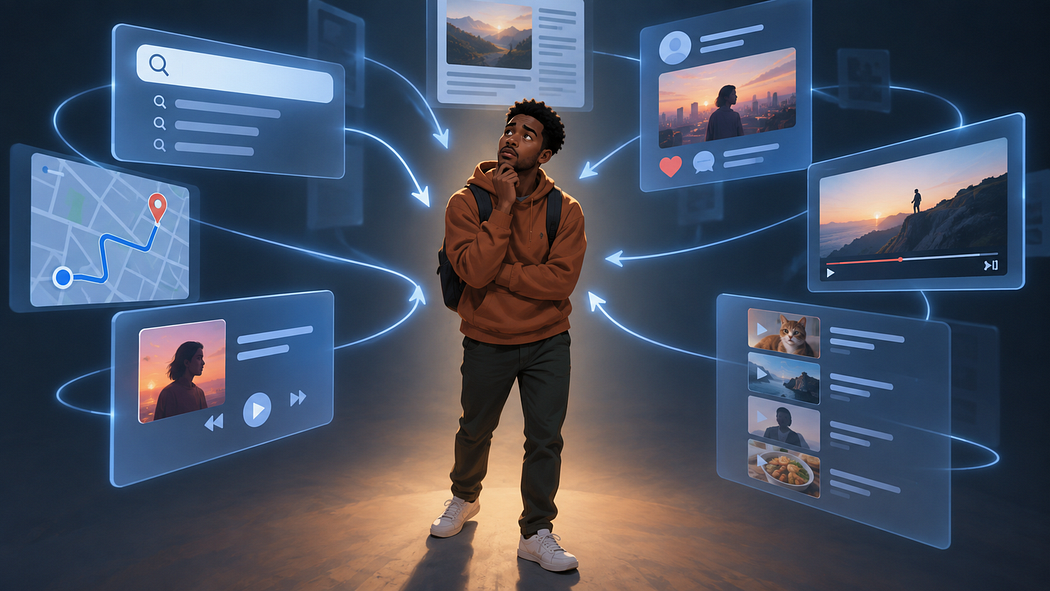
And this conversation is actually bigger than generative AI.
Over the last few years, we have concentrated so much on ChatGPT, Claude, Gemini and all these new models that we sometimes forget that other systems have quietly become extraordinarily intelligent too.
TikTok has become frighteningly good at understanding what keeps us watching. Instagram knows what we are likely to engage with, Google predicts what we are searching for before we finish typing, Spotify increasingly decides what we might enjoy listening to next, Google Maps decides which road we should take, and YouTube chooses what it thinks we should watch afterwards.
None of these things individually makes us less intelligent.
They are useful.
But notice the direction.
More and more tiny decisions are disappearing from our lives.
What should I watch? What should I listen to? Where should I go? What should I read? What does this article say? How should I structure this email? What does this dataset mean? How should I write this code? What should I do next?
The machines are becoming better at predicting us, guiding us and removing the friction between wanting something and receiving an answer.
But judgment is partly developed through friction.
Choosing something.
Getting it wrong.
Experiencing the consequences.
Reflecting.
Trying again.
We spent years teaching machines to understand us.
Maybe we should now spend some time asking what happens when we stop needing to understand things ourselves.
Are We Becoming the Artificial Intelligence?
AI getting smarter is not the problem.
I want it to get smarter. I want it to write better code, analyse bigger datasets, automate boring work, help doctors, help teachers, help businesses and allow ordinary people to create things that previously required huge teams, large amounts of capital and skills that took years to acquire.
That is exciting.
But perhaps the more capable the machine becomes, the greater our responsibility becomes too, because once everyone has access to intelligence, intelligence itself stops being the differentiator.
The intern has Claude, the analyst has Claude, the manager has Claude, the CEO has ChatGPT, and your competitor has all of them.
So what remains?
What remains is everything we have been quietly underestimating: curiosity, context, experience, failure, domain knowledge, conversations with real people, understanding consequences, and the ability to look at an answer that appears perfectly reasonable and still ask:
“But does this actually make sense here?”
That is judgment.
AI is getting smarter.
I don’t think we should be afraid of that.
The more interesting question is whether we are becoming wiser alongside it.
Because perhaps the greatest risk isn’t that machines eventually acquire human intelligence.
Maybe the stranger possibility is that humans become so comfortable outsourcing thinking that we slowly become the artificial layer ourselves.
And that leaves me with one question — one that I think every analyst, software engineer, manager, founder, student and CEO should occasionally ask themselves:
If AI disappeared tomorrow, how much intelligence would remain with you?