
Unfortunately, It Feels Like They Now Want Tool Mastery Rather Than the Art
By Ezra Muinde on Oct 8, 2026 - 10 min read
Ubuntu Analytiq insight“The new mastery might be knowing which tool to use, which one to ignore, and when Excel is still perfectly fine.” — Yours Truly💀
I had started an interesting article on Power BI and Excel, because these tools ain’t getting any old — I mean, they are, but you all are still using them.
And honestly, I am not sure data will ever completely make sense without rows and columns.
There is something almost comforting about putting information neatly into cells, adding a few filters, maybe colouring one column yellow for reasons nobody will remember three months later, and suddenly feeling like we have brought some order to the universe.
That piece has stayed with me for a while now, and I think it is finally time to write it.
Although somewhere along the way, what I thought would be an article about Power BI and Excel became an article about AI, tools, integration, mastery and, perhaps, what it now means to actually be good at your job.
I also feel like this piece has been heavily inspired by my new role, because being at the back-end — or being the back bencher I have always been — gives you an interesting opportunity to see almost everything happening in front of you.
You see where the data comes from, where it gets stuck, where it is cleaned, where it is stored, where Power BI eventually picks it up, and increasingly, where somebody somewhere asks the inevitable question:
“Can we put AI on top of this?”
And lately, all of this has left me thinking about something slightly uncomfortable.
Unfortunately, it feels like they now want tool mastery rather than the art.
I say unfortunately, but I am no longer completely sure whether that is unfortunate, because AI has complicated the whole idea of mastery itself.
There was a time when learning Power BI meant actually learning Power BI. You learned Power Query, relationships, data modelling, DAX, filter context and, eventually, how to communicate something useful without building a dashboard that looks like someone discovered every colour in the theme pane and decided to use all of them.
There was an art to it, and you could spend years becoming very good at that art.
The same was true with Excel, where people built careers around formulas, pivot tables, VBA, financial models, macros and the almost supernatural ability to open an ugly workbook created in 2017, stare at it for five minutes, and somehow understand what the original author was trying to do.
That was mastery.
Then AI came along.
Today, AI can write the formula, suggest the DAX, clean the data, create the pivot, explain why your formula is broken and probably fix it too. With the right workflow behind it, it can generate the report, summarise what happened and send it to your boss on Monday morning before you have even opened your laptop.
Which leaves us with a slightly awkward question:
What exactly are we mastering now?
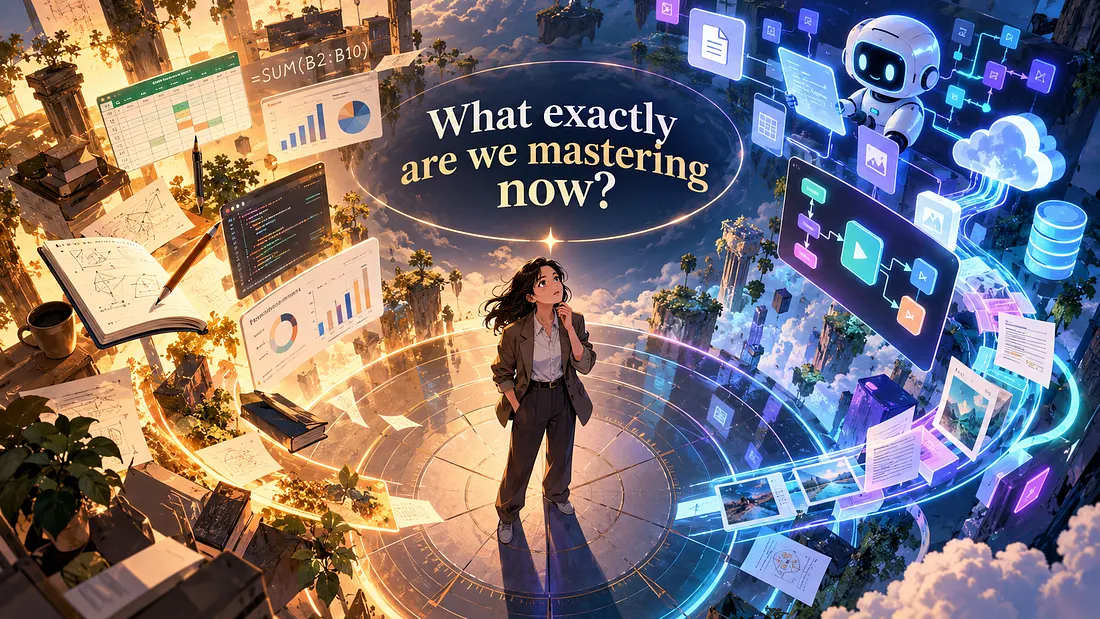
Because before someone has even fully mastered Power BI, organisations are already asking for AI/BI dashboards, Copilot, natural-language querying, semantic models that AI can understand and agents that can answer questions directly from organisational data.
You are still somewhere trying to understand filter context and somebody is asking, “Can I just talk to the dashboard?”
Relax.
I have not even finished arguing with DAX yet.
But perhaps the organisation has a point.
If someone can ask, “Why did sales fall in the Coast region last month?” and the system can inspect the data, generate the right analysis, produce a visual and explain what happened, then the value of manually knowing where every button sits inside Power BI starts changing.
Not disappearing.
Changing.
Then I started thinking about Row Zero
Row Zero has been sitting in my head because it is one of the clearest examples of what I think is happening.
Why would somebody build another spreadsheet when Excel already exists, has existed for decades, has millions of users and has somehow survived every prediction that it is about to die?
Because Excel solved the spreadsheet problem incredibly well, but the world around the spreadsheet changed.
Data got bigger, organisations moved into cloud warehouses and lakehouses, teams started working with systems like Snowflake and Databricks, automation became more important, and now AI agents are slowly becoming users of these systems too.
The spreadsheet no longer only needs to serve a human sitting in front of a laptop wondering why VLOOKUP is returning #N/A.
It needs to connect.
It needs to scale.
It needs to automate.
And increasingly, it needs to work for both humans and agents.
That is what makes Row Zero interesting to me. It does not necessarily reinvent the art of working with rows, columns, formulas and pivots, because that art was already there; instead, it asks what the spreadsheet should look like when the data is much larger, when it already lives in the cloud and when the thing interacting with the spreadsheet might not even be a person.
And once you think about it this way, even Excel mastery starts meaning something different.
If AI can write formulas, create pivots, analyse the workbook and trigger reports automatically, then perhaps being excellent at Excel in the future is not about memorising two hundred functions.
Maybe it is about knowing when Excel is enough, when it has reached its limit, when Row Zero makes more sense, when the data should probably sit in a warehouse, when Power BI should take over and, occasionally, when the whole thing should never have been a spreadsheet in the first place.
That is a different kind of mastery.
The people building these tools understood the problem first
Another part of this that I find fascinating is how many people leave large technology companies and go out to build tools.
Often, they are not randomly inventing software because somebody on startup Twitter told them to build in public. They have lived with a problem, experienced its limitations and understood the system deeply enough to see where something could be better.
Then they build the tool.
That matters because the tool came after understanding the work.
There is an irony there.
The people building the tools we are now rushing to master often became capable of building them because they first understood the underlying art, while the rest of us increasingly experience the process in reverse.
A new tool appears, so we learn it.
A new model gets released, so we test it.
A new agent framework shows up, so we add that too.
Microsoft announces another thing, and apparently that is now part of the job.
Databricks announces something else, so we learn that on Tuesday.
By Friday there will probably be another one.
And suddenly, mastery itself becomes a moving target.
AI has heavy-lifted a lot of the art
The recent competition among AI companies makes this even more obvious to me, because increasingly the conversation is no longer simply about what humans can do; it is about which model can do the work better.
Which one codes better?
Which one analyses better?
Which one reasons better?
Which one handles spreadsheets better?
Which one is better at agentic work?
Which one can take a task from beginning to end with the least intervention?
At some point, we are no longer only benchmarking ourselves.
We are benchmarking the worker we are about to delegate the task to.
And that changes our relationship with mastery.
If one model is better for one job, another works better for something else, Copilot is already embedded inside Microsoft, Claude is connected somewhere else and Databricks has its own AI capabilities, then part of the human role becomes knowing which one to use, for what, connected to which data, with which permissions, at what cost and with what level of trust.
AI has heavy-lifted a significant amount of the execution of the art, while humans are increasingly being pushed towards orchestration.
And perhaps that is why tool mastery suddenly matters so much.
Companies have already built themselves into ecosystems
For years, we have been told that tools do not matter and that what really matters is understanding the fundamentals.
Which sounds very wise.
Until you apply for a job.
Then suddenly the tools matter quite a lot.
If an organisation has invested heavily in Microsoft, Power BI matters, Fabric matters, Power Apps matters, Azure matters and Dataverse matters. If the organisation runs on Databricks, then Databricks matters; if it uses Snowflake, AWS, dbt, Salesforce or another ecosystem, those tools inevitably become part of the job.
And I think the reason is fairly simple.
Companies have invested too much in licences, infrastructure, APIs, security, identity, governance and integration for the tools not to matter.
At some point, the architecture becomes part of the organisation itself.
We even have engineering functions increasingly focused on integration — making System A talk to System B, ensuring System C can read from System A but should absolutely not be allowed anywhere near System D, moving data, transforming it, authenticating users, monitoring pipelines, managing APIs and orchestrating workflows.
And now, naturally, connecting AI to all of it.
Which brings me to something I am starting to see directly.
I am increasingly getting DMs from clients who are not necessarily asking, “Can you teach us Power BI?”
Instead, the conversation sounds more like:
“We have an ERP. How do we get the data out, clean it, store it, connect Power BI, allow Claude to analyse it, put an agent on top and automate the whole thing?”
That is a completely different question.
ERP → clean data → data storage → Power BI → Claude / Agentic AI.
Nobody is really talking about one tool anymore.
They are talking about the spaces between the tools.
And maybe that is where the job is moving.
Maybe integration is becoming the art
This is where my own argument starts fighting with itself.
I began with: Unfortunately, they want tool mastery rather than the art.
But what if knowing how the tools fit together is becoming part of the art?
Because understanding that entire chain requires more than knowing where to click. You need to understand where data should live, what should be transformed, what belongs upstream, what Power BI should handle, what an agent should be allowed to access, where security sits and where human review still matters.
You also need to know when you do not need AI at all.
That last one may become a premium skill, because at the moment everything apparently needs AI.
Dashboard? AI.
ERP? AI.
Customer service? AI.
Coffee machine? Give them time.😂
But is any of this actually saving money?
This is the part I genuinely do not have a clean answer to yet.
Are we actually saving companies money and time, or are we partly chasing the AI wave because nobody wants to be the organisation that apparently missed it?
I can clearly see the productivity gains.
Things that took hours can take minutes. Code gets written faster, reports get automated, analysis happens faster and one person can sometimes do work that previously required several people.
That is real.
But then I look at the other side and see cloud costs, AI subscriptions, API consumption, Fabric capacity, Databricks, Power BI licences, integration engineers, security, governance, agent platforms, monitoring systems and consultants.
And somewhere in the middle of all this, somebody still needs an Excel licence.
So I keep wondering:
Did we remove the cost, or did we simply move it?
Perhaps we are replacing some manual execution with an ecosystem of sophisticated tools, then hiring people whose job is to keep that ecosystem alive. That is not necessarily bad, but it is worth noticing because maybe we are not simplifying work as much as we are changing the architecture of work.
And I think both things can be true at the same time.
AI can be genuinely transformational while companies still overbuy it.
AI can save time while organisations still waste money implementing it badly.
The technology can be real while the bubble around it is also real.
We have seen that movie before.
So where does that leave mastery?
I started thinking this article was about us losing the art because everyone suddenly wants Power BI, Fabric, Databricks, Claude, Copilot, agents, APIs and whatever else gets announced next Thursday.
I am less sure now.
Maybe the art has not disappeared.
Maybe it has moved.
There was a time when the craft sat very close to execution, because being good meant knowing how to write the formula, build the dashboard, create the query, design the model and construct the pipeline.
Today, AI increasingly helps with those things, so perhaps the human craft moves one level higher towards understanding the problem, designing the system, choosing the right tool, connecting the pieces, providing the right context and deciding what should be automated.
It also means being knowledgeable enough to notice when AI gives you a beautiful, confident and completely wrong answer.
That part matters.
Because the prettier AI gets, the more dangerous bad foundations become.
So perhaps the future does require tool mastery, just not the kind we used to mean.
Maybe mastery is no longer about memorising every menu, collecting twenty certificates so LinkedIn can congratulate you, or knowing every DAX function.
Maybe it is about understanding the ecosystem well enough to move through it without becoming trapped by it.
Knowing Excel, but also knowing when Excel has reached its limit.
Knowing Power BI, but also knowing when the user does not actually need another dashboard.
Knowing Claude, Astra, Fable and whatever comes next, but more importantly knowing why you are calling the model in the first place.
Because if AI continues getting better at the execution, our advantage probably cannot remain:
“I know how to click the buttons better than you.”
It has to become something else — judgment, context, systems thinking, integration, taste, and enough understanding of the underlying art to recognise good work while knowing enough about the tools to make that work happen.
And maybe that is the uncomfortable part.
We are being asked to master tools that are themselves being redesigned so that we do not have to master them.
Funny, isn’t it?
I am still not sure whether that is progress, but I am increasingly convinced that it is the kind of progress we need to understand.